
'At least you know what not to do in the future. Even that failure becomes a success in the larger scheme of things.'

Higher valuation creation in companies beyond the top 100 has given the domestic markets a shot at a $4 trillion market capitalisation (mcap) - a club exclusive to three countries currently. On November 23, the mcap of all BSE-listed stocks finished at a new record of Rs 328.33 trillion ($3.94 trillion), despite the benchmark indices ending with losses. The mcap was propelled by gains in the broader market, including small and midcap stocks - a trend dominant this year.

He also called upon the government and other stakeholders to streamline the processes where an athlete could just concentrate on his training and performance without having to bother about other issues.

The country's per capita income is likely to grow by close to 70 per cent to $4,000 by fiscal 2030 from $2,450 in fiscal 2023, helping it become a middle-income economy with $6-trillion GDP, more than half of which will be coming in from household consumption, says a research report. Per capita income/GDP has risen from $460 in fiscal 2001 to $1,413 in fiscal 2011 and further to $2,150 in fiscal 2021. The biggest growth driver will be external trade which may nearly double to $2.1 trillion by 2030 from $1.2 trillion in fiscal 2023 when the GDP printed in at $3.5 trillion, Standard Chartered Bank said in a weekend report which assumes a 10 per cent nominal GDP growth annually from now on.

Most analysts have downgraded the stock of SBI Cards and Payments (SBI Card) as the credit card issuer posted weak results during the December quarter (Q3) of financial year 2023-24 (FY24). The sub-par show, analysts said, was for the eighth straight quarter. With this, they have slashed their earnings estimates by as much as 20 per cent over FY24-26 amid near-term pressure points in the company's growth outlook.

Assuming we still have a Modi-led majority government after May 2024, there is no guarantee that reforms will move at anything more than a snail's pace, though we must be thankful even for that, notes R Jagannathan.

If the BJP gets only 200 seats and wants to remain in power, Modi will have to make way -- either for a proxy of his choice, or for an internal rival, predicts Nilanjan Mukhopadhyay.


The country's gross domestic product (GDP) growth is likely to be 8.8 to 9 per cent in the current financial year, driven by agriculture and industry sectors, Care Ratings said in a report. The country's economy had contracted by 7.3 per cent in fiscal 2020-21. The agency said the outlook for the Indian economy on almost all counts in FY22 would look seemingly better than FY21 on account of the negative base effect.

About 1.2 crore passengers flew in November compared to 1.1 crore in October. While the industry opinion is divided over the sustainability of unprofitable growth, which is primarily led by low fare, some described it as the resilience of air travel against the economic slump.

'While most companies were bullish before the second wave of double-digit sales growth in FY22, that may not be the case now.'

India will never provide company or enterprise-specific incentives in the electric vehicle sector, a top government official said on Friday, amid a push from American electric carmaker Tesla for special sops to set up its factory in the country. If the government has to consider providing incentives then it will only be for all EV makers and entrants who want to come to India, the official said. The official added that inter-ministerial discussions have happened on the customs duty concession demand of the US-based electric car maker Tesla, but "we never" came to any conclusion on those.

In its mid-quarter review of monetary policy, RBI on Wednesday kept all key interest rates unchanged notwithstanding persistent high inflationary pressure.

'Investors should ideally consider equity allocations from a medium-to-long term perspective.'

India's gross tax revenue, comprising both direct and indirect taxes between April and July, reported a growth rate of merely 2.8 per cent to Rs 8.9 trillion compared to the same period a year ago, as shown by government data on Thursday. This growth was dampened by direct tax figures, offsetting the healthy growth in goods and services tax collections and Customs duties. While net tax revenue contracted by 12.6 per cent to Rs 5.8 trillion up to July, accounting for 25 per cent of the Rs 23.3 trillion full-year target, this could be attributed to the increased tax devolution to states during the period.

Recently, the government relaxed foreign direct investment (FDI) norms for the space sector by allowing 100 per cent FDI in manufacture of components, systems or sub-systems for satellites, ground segments, and user segments. It also permitted 74 per cent FDI in satellite manufacturing and operation as well as satellite data products and 49 per cent in development of launch vehicles and spaceports. Following this, stocks of related companies saw an uptick on the bourses.

Backed by the 'China Plus One' sentiment globally, India's textile exports is expected to grow by 81 per cent to $65 billion by 2026 from the pre-Covid level of around $36 billion in 2019, said a report by the Confederation of Indian Industry (CII) and global consulting firm Kearney. This jump is likely to generate 7.5-10 million new jobs. A large chunk of this targeted increase, or around $16 billion may come from the China Plus One sentiment due to India's relatively large strategic depth compared with Vietnam or Bangladesh, the report said.

Manufacturing sector activities in India moderated in June from a 31-month high in May, but output remained in the growth territory, as new work orders expanded sharply amid favourable demand conditions, a monthly survey said on Monday. The seasonally adjusted S&P Global India Manufacturing Purchasing Managers' Index (PMI) fell from 58.7 in May to 57.8 in June. Despite the fall, the headline figure pointed to a considerable improvement in operating conditions, the survey said, adding that the demand strength positively impacted several other measures such as sales, production, stock building and employment.

'The assumed linear correlation between forced lower yields, higher bank borrowing from the RBI, higher lending, and higher growth involves leaps of faith, each a step on the quicksand of false beliefs,' warns Debashis Basu.

After contracting for two quarters in a row, the Indian economy entered the positive territory with a growth of 0.4 per cent in the October-December quarter, mainly due to good performance by farm, services and construction sectors, official data showed on Friday. Trade and hotel industry registered a contraction of 7.7 per cent during the third quarter this fiscal, as the sectors continued to suffer on account of coronavirus pandemic. According to the data released by the National Statistical Office (NSO), the farm sector recorded a growth of 3.9 per cent, and the manufacturing sector output grew by 1.6 per cent in the quarter under review.

'SUV is a very intensely fought category, unlike hatchbacks and cars.'

'As our per capita income increases and various demographic segments emerge, the need for various kinds of protection and risk covers will become even more explicit.'

However, the World Bank has projected India's GDP growth rate at 7.5 per cent for the next three financial years, including the current one.

Mukesh Ambani's Reliance group has struck acquisition deals worth $4.2 billion with a dozen companies in just two years to expand its retail business. The latest purchase was of a majority stake in Justdial for Rs 3,497 crore. Elaborating on his acquisition strategy a few weeks ago during the AGM, Ambani stated that one of the key planks would be to acquire businesses that enhanced Reliance's offerings and experiences to customers and that they would be both physical and digital.

'If you want it to grow well and serve the true needs of the economy, it needs a lot of freedom and flexibility, which comes in terms of the reform objective set by the regulator.'

Bank credit growth declined to 8.5 per cent in January from 13.5 per cent in the year-ago period.

Work on a dozen decisions to start by next week.

Passenger vehicle wholesales in India rose to a record high in October as companies pushed dispatches to dealers to cater to the enhanced demand in the festive season. The overall passenger vehicle wholesales in October rose to 391,472 units, up 16 per cent from 336,679 units in the same month last year. Last month witnessed the highest-ever dispatches of passenger vehicles in the domestic market by Maruti Suzuki India and Mahindra & Mahindra.
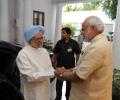
'The sense of Constitutional propriety and political morality seems to be vanishing fast.' 'There are many things in today's politics of governance which Manmohan Singh would have never dreamt of saying or doing.'

The Budget, to be presented on February 1, is likely to be less worried about fiscal deficit and will be focused more on nursing the fragile growth, according to a Wall Street brokerage report. Bank of America Securities India expects the budget to peg "fiscal deficit at a high 5 per cent of GDP for FY22 and 7.2 per cent for FY21, as it is likely to step up capex, recap public sector banks, push asset sales to break government monopolies, offer sops for real estate, tax cuts for lower income groups and creation of a bad bank". Its house economists expect these spends to be funded by debt and partly by imposing a cess on high income groups and also by some non-fiscal measures like tapping the central bank's revaluation reserves and bank recapitalisation and infra bonds.

24x7 power supply to farmers emerges as a political lightning rod in the state.

Life insurance companies reported a 17 per cent year-on-year (YoY) drop in new business premium (NBP) in February as state-owned Life Insurance Corporation of India's premiums contracted 32 per cent during this period on account of a drop in its group single premium segment. According to data released by the Life Insurance Council, the industry earned an NBP of Rs 22,847.65 crore in February - a drop of 17 per cent from the same period a year ago.

Core sector companies have seen volumes drop to single digit in the first nine months of FY16.

The share of foreign companies in private sector investments, directed towards building new factories and other facilities, has declined over the past six months. A mix of large domestic announcements and relatively lower growth in foreign capital expenditure (capex) plans have played a role, although foreign investments remain near record levels. The share of foreign companies in the overall private sector investments over the four quarters ended June 2023 has dipped to 14.9 per cent, as shown by a Business Standard analysis of data from the project tracker Centre for Monitoring Indian Economy.

Tata Communications on Wednesday announced that it would acquire NYSE-listed Kaleyra, a global omnichannel integrated communication services provider with a set of proprietary platforms offering targeted personalisation through messaging, video, push notification, e-mails and voice-based services, and chatbots. The acquisition is an all cash deal. Tata Communications has agreed to acquire Kaleyra at a price per share of $7.25, for a total consideration to Kaleyra shareholders of approximately $100 million, besides the assumption of all outstanding debt.

Retail sales of automobiles in the domestic market saw a 7.73 per cent year-on-year decline in October this year at 21,17,596 units, mainly due to dip in two-wheeler uptake with the inauspicious period of Shraddh affecting new purchases, the Federation of Automobile Dealers Associations (FADA) said on Monday. Retail sales of automobiles in the domestic market stood at 22,95,099 units in October 2022, FADA said in a statement. Two-wheeler retail sales were at 15,07,756 units last month, as against 17,25,043 units in the year-ago period, down 12.60 per cent, as per the latest data by FADA.

Government incentives to grow rice and wheat as part of a subsidised food programme for the poor also keep prices high.

Digital, new energy, supply chain resilience and health will be the themes of the over $100-billion Tata group's strategy going forward, according to its chairman N Chandrasekaran even as he asserted that all ambitions are contingent on learning to live with the coronavirus. In his New Year address to the over 8 lakh employees of salt-to-software conglomerate, Chandrasekaran said businesses and society must adapt to the virus by preparing as "best we can for new outbreaks and variants. We are seeing this now with the spread of Omicron". Reflecting on the year gone by, he said the group is becoming "simpler and financially stronger than we have been in a long time".

Very often, 'sentiment' drives prices well beyond what is warranted and it is hard to forecast market sentiment, explains Debashis Basu.

Showing concerns over hardening inflation, the Reserve Bank today left the key interest rate unchanged but reduced cash reserve ratio by 0.25 per cent to inject Rs 17,500 crore (Rs 175 billion) liquidity into the financial system.
 © 2026 Rediff.com - Advertise with us - Disclaimer - Privacy Policy - Sitemap - Feedback - About us - Terms of use - Grievances